
Breadcrumb
Understanding and Basics of Hedging Strategy
0/5 Stars Reviews (0) | 02 Feb 2025 / | Stock Market | Shekhar D | Visitor's : 47
Hedging Strategies in the Indian Stock Market
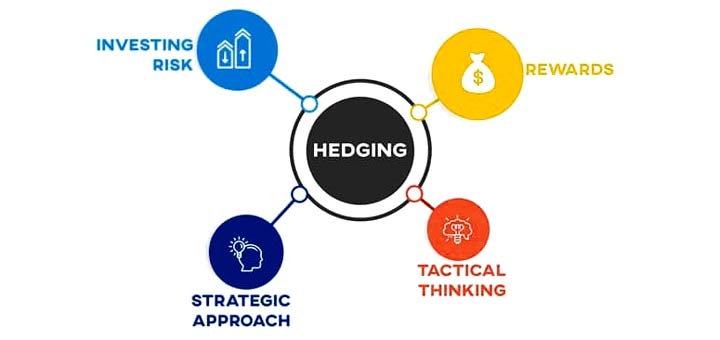
Investment or financial risk hedging (or hedging strategy) is a method that aims at minimizing the risks of loss of an investment due to price fluctuations in a financial market. Hedging is one of the most common strategies in the Indian stock market that individual investors and institutional investors utilize in order to control risks and sustain returns. Traders can hedge their underlying exposures by entering a combination of positions in financial markets.
Why do we need to hedge?
The Indian stock market is subject to many influences, including, among others, the state of the economy, political tensions, regulatory changes, and developments in the international markets. This creates a highly volatile and uncertain environment. When markets become unstable, a solution is needed to abolish market risk as much as possible, and this is where hedging comes into concern.
Hedging Strategies in the Indian Stock Market
Hedging does not only involve the use of financial instruments but also the use of many other strategies. Below is a listing:
a) Derivatives hedging
Futures: Investors can utilize stocks and index-conditioned futures to create a price band as a hedge against adverse price movements in the market. As an example, consider the Nifty 50 as a spectrum of stocks that you possess and will decline; in this case, short-selling Nifty Futures is utilized as a perfect operational hedge.
▪ Options: In the market, options give a trader the right, and not the duty, to either buy or sell a certain stock at a given price. Making provisions for buying put options is an acceptable method to mitigate the risks associated with stock price decreases.
b) Commodity hedging
▪ Certain commodities, such as gold and silver, are well known for their ability to offer protection against inflation or stock crashes. Investors add these defensive assets to their investments.
c) Strategic Diversification
▪ Investors can lessen the risk of downfall in one or another market or sector by distributing investments between different sectors, asset types, and regions.
d) Pairs Trading Strategy
This strategy also aims to capitalize on the inherent positive correlation between two stocks. For example, if you predict that Reliance Industries will experience a better performance than Tata Steel, you may purchase the Reliance shares while shorting the Tata Steel shares at the same time.
e) Currency Sorcery
Investors with overseas assets or earnings can manage their diverse currency risks through currency forwards, futures, or options.
Pros of Hedging
a) Risk Reduction: Hedging has been employed to bring down specific financial risks inherent in the occurrence of adverse price changes.
b) Partial Investment Diversification: Such a hedging mechanism satisfies a requirement that there has to be some part of the portfolio that is not subjected to market swings.
c) Financial Objective: Without the ‘tag along’ risk, investors can plan their financial objectives inwardly with more precision.
d) Adaptability: Derivative products can avail strategies that can fit a variety of risk, hunger, and market environments.
Indian Market Application of Derivatives as Hedging Tools
a) Single Stock Hedging: Consider the simple scenario in which you possess 1,000 units of Infosys shares, currently trading at Rs 1,500, and envisage some short-term instability due to results season. In this case, to manage the risk, you buy put options on the same stock with a strike price of Rs 1500. Profits from a fall in the stock price would be offset by losses in holdings due to the downmove, but the drop wouldn't be equally mitigated.
b) Index Tracking: If an investor owns a portfolio that tracks the Nifty 50 index, the investor can hedge market declines by selling Nifty index futures.
c) Industry Hedging: In case you have already invested significantly in banking and expected some regulation, then you would try to protect it by shorting banks’ index or Bank Nifty.
Making the Most of Hedging
Hedging invariably contains some downside risk but, at the same time, limits any upside profit opportunity as well. You can take the following actions to strike a balance:
a) Deploy minimum hedging: Do not hedge all of the portfolio so some of the market risk is retained.
b) Use the least expensive tools: Compare the cost of various derivatives and go for the ones with the least premium.
c) Comprehensively assess the hedge in regular intervals: Every market condition is subject to change, and so is the hedging practice.
Execution
The Indian market has a hedging solution, and that is not a practice in vain, as it assists in a protective strategy concerning the investors in the market. Learning about these hedging instruments and applying them appropriately in brewing coffee can enable investors to reduce and rather capture risk out of the market. Before deciding to use a hedge, one must consider the costs and benefits associated with any action. Within the limits of this same practical approach, it is also possible that hedging becomes, at no time, a less effective measure.