
Breadcrumb
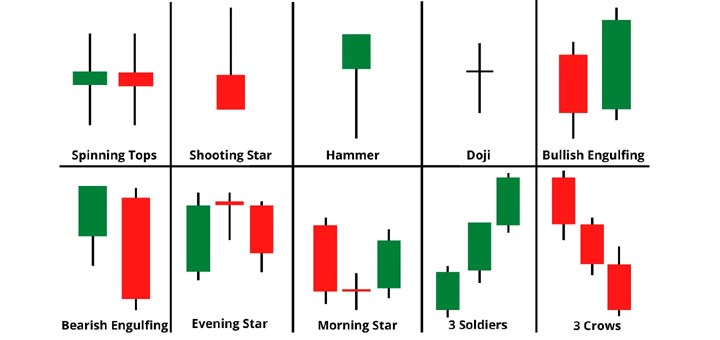
Simple Candlestick Patterns
0/5 Stars Reviews (0) | 02 Feb 2025 / | Financial News | Shekhar D | Visitor's : 46
Candlestick patterns are a visual depiction of technical analysis and are one of its numerous tools.
Simple Candlestick Patterns
Candlestick patterns are a visual depiction of technical analysis and are one of its numerous tools. Before learning to read charts, a novice must first understand the visual characteristics that serve as indicators of market sentiment or potential price moves. Learn some preventive candlestick patterns, understand the fundamentals of candlestick chart interpretation, and get answers to the majority of frequently asked questions in this tutorial.
Comprehending simple candlestick diagrams.
One kind of financial chart that shows the movement of prices over a given period is a candlestick chart. Each candlestick provides information about the four important data points:
1. Open Price: The asset's opening price at the start of trade.
2. Close Price: The price at which the asset's trading for the duration came to an end.
3. High Price: The highest price attained throughout that time frame.
4. Low Price: We achieved the lowest trading price during the period.
What's a candlestick?
The body is the rectangular portion of a candlestick that shows the range between the open and closed prices.
The market closes at a higher price than it started; therefore, a green or white tint indicates a positive tendency.
Body: Because the market finishes at a lower price than it started, a red or black color denotes a negative tendency.
• Wicks/Shadows: The highest and lowest prices on the candlestick are obviously visible as thin lines jutting from the body above and below.
• Length: The volatility is wider the longer the body and wicks are.
Beginner-friendly Candlestick Patterns
First line: Doji
· Appearance: tiny body; both sides have almost similar wick lengths.
· Importance: Shows a lack of decisiveness in trade.
· Interpretation: Look for confirmation of a bullish or bearish price trend.
Second Line: Hammer
It has a small body that reaches close to the top, and the wick nearly touches the rest of the candlestick.
Significance: After a downward trend, there is a chance for reversal.
For instance, it indicates the purchasers who are on the move when it appears near the bottom of a downward trend.
Shooting Star (Line 3):
A significantly smaller body with a lengthy top wick is visible in the low segment.
Significance: An indication of a bearish reversal.
Example: This signifies the entry of the sellers into the transaction, which occurs following an uptrend.
Line 4: Engulfing in a bull market
In terms of appearance, the previously consumed red candlestick is replaced by a comparatively huge green one.
· Significance: bullish; denotes a time of strong buying.
The example suggests that a bullish shift will likely follow a downturn.
Line 5: Engulfing in a bearish mood
Look: The previous large green candlestick now encases the newest large red one.
Importance: Strong sales.
The penultimate end of an uptrending index is indicated by bearish movements, for instance.
A Morning Star in Line 6:
· Look: There are three candlesticks in this pattern; the first two are red, and the Doji, or white, candle is usually the white one.
· Significance: Indicates a bullish turnabout.
As an illustration, you can identify it, though it's not always required, in the midst of a downward trend.
Line 7: The Evening Star
· Look: This pattern features three different kinds of candlesticks: red, short-body, and green.
Meaning: This signifies that the market is completely in a bear market.
· Illustration: Decline in a more robust uptrending setting.
Hanging Man (Line 8):
In terms of appearance, it looks a lot like the next Hammer, but it is currently rising, and the price has dropped to a lower low.
Significance: A bearish reversal indication.
· Example: It indicates that sellers will take control following a strong rally.
Advice for Newcomers
1. Begin by examining basic patterns: Doji, Hammer, and Engulfing patterns are simple main patterns that are well-known and will give you a foundation in fundamental information.
2. Use volume to verify: To ensure that all signals are present, use a high trading volume.
3. Add indicators: For further reassurance, use moving averages, RSI, or MACD.
4. Practice on Demo Accounts: Get comfortable identifying—the most crucial thing—without having to risk any real money.
5. Have patience: Sometimes quiet time turns out to be the ideal occasion; not all patterns are at the correct time.
In conclusion,
Candlestick patterns are among the best instruments for illustrating the spirit of the market and its price changes. Discover how fundamental patterns can be used in conjunction with other technical analysis methods to have a favorable result when trading flexible options. Start by practicing the basic ones, and then as your confidence grows, let the more complex ones take over.