
Breadcrumb
Forex Trading: Currency Pairs, Strategies, and Regulations
0/5 Stars Reviews (0) | 05 Feb 2025 / | Forex | Shekhar D | Visitor's : 196
With knowledge, strategies, and abiding by laws, traders can potentially increase their chances of profiting from the inherently volatile world of forex trading.
Forex Trading and Currency Pairs
Foreign exchange, or forex, is the process of selling and buying different currencies within the global financial market. It is one of the largest markets with high liquidity and fluctuating economic diversion for traders of all levels, be they newbies or institutional investors. This guide provides insights into forex trading, featuring peculiarities of currency pairs, benefits, trading strategies, challenges, and risks, apart from forex trading scenarios in India and related rules.
What Are Currency Pairs?
In forex trading, currency pairs allow the exchanging of one currency for another, relative to some value. The first currency in the pair is referred to as the base currency, while the second is called the quote currency.
Types of Tradeable Currency Pairs
1. The Major Pairs
These involve the most traded currencies in the world, including the United States Dollar (USD).
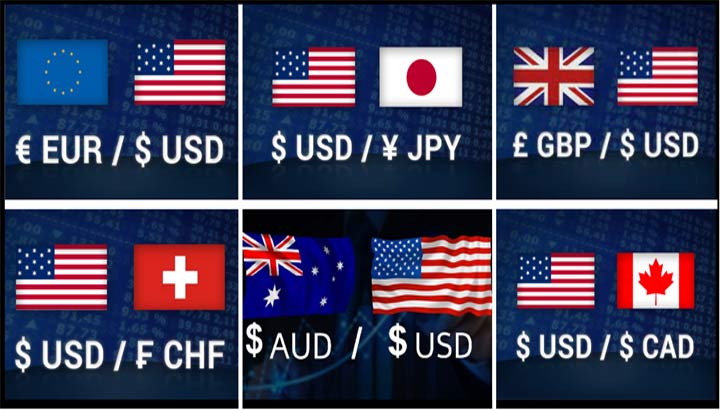
Examples of major pairs include EUR/USD, GBP/USD, USD/JPY, and USD/CHF.
2. The Minor Pairs
These are simply major pairs subjected to a minor adjustment, excluding the US dollar. Other solid currencies, such as the euro or the British pound, would fit into this pair category.
Examples of minor pairs include EUR/GBP, GBP/AUD, and EUR/JPY.
3. The Exotic Pairs
An infrequent type of pairing, the exotic pair contemplates a major currency paired with a weak currency such as emerging markets or other less liquid currencies.
Examples of exotic pairs are USD/TRY (Turkish Lira) and USD/SEK (Swedish Krona).
4. Cross pairings
These pairs often exclude the U.S. dollar and involve two major currencies.
Examples of cross pairs include AUD/CAD, EUR/CHF, and NZD/JPY.
Understanding the types of currency pairs, among other things, is fundamental, as each pair has different reactions teconomic news, market trends, geopolitical repercussions, and other factors.
Advantages of Forex Trading
Forex trading has its advantages, which make it a popular choice among traders:
1. High Liquidity
The forex market operates 24/5, and its daily trading volume exceeds $6 trillion, which ensures a high level of liquidity.
That makes it really easy to get in and out of trading quickly and at any point.
2. Low Transaction Costs
Forex brokers generally charge low spreads (the difference between the bid and asking price), which are trading costs.
3. Leverage
Forex trading allows traders to trade large position sizes for a relatively small amount of invested capital because of the leverage.
For instance, a leverage ratio of 1:100 would allow a trader to buy, say, $10,000 with just $100.
4. Diverse Trading Opportunities
The market offers a variety of instruments, such as currency pairs, CFDs, and indices, which appeal to a large number of trading styles.
5. Accessibility
Forex trading is accessible to individuals with small investments, thanks to micro and mini trading accounts.
6. The global market
It is a global market; forex trading is affected by happenings worldwide, giving numerous opportunities for shrewd traders.
Forex Trading Strategies
A successful forex trader has mastered various strategies to respond to diverse market circumstances and tailor them according tthe risk tolerance dictated by himself. Here are some popular strategies:
1. Scalping
Traders initiate numerous trades within minutes or seconds to snap up minor price movements.
Effective scalping calls for precision, fast decision-making, and low spreads.
2. Day Trading
Running all positions out of the trading day serves as a means of avoiding overnight risks.
We closely track short-term price movements.
3. Swing Trading
This relatively slow-paced strategy effectively capitalizes on medium-term trends over a period of a few days to a few weeks.
This method is effective for traders who are unable to continuously monitor the markets.
4. Position Trading
Returns are accrued over a long period since trades are held for several months or even years, depending on the strategy.
We use fundamental analysis tpredict major economic trends.
5. Trend Following
Traders jump on the moving boat and float wherever the trend is leading them.
We commonly use moving averages and trendlines as indicators.
6. Breakout Trading
Breakout entails entering a trade as the price breaks through the resistance or falls through the support level.
This often signifies the emergence of a new trend.
7. Carry trades.
Gambling on the differential in interest rates between two currencies.
An example could be selling a shorted low-yield currency and purchasing high-yield currencies.
Before using each in live trading, test it in demo accounts to weigh its advantages and disadvantages.
Challenges and Risks of Forex Trading
Despite its positive aspects, the forex market presents a variety of risks and challenges that require careful management.
1. High Volatility
Foreign exchange prices might experience phenomenal volatility in very short periods, leading to gigantic gains or huge losses for the invested principal.
2. Leverage Risks
Leverage enhances the magnitude of profits significantly, but it also magnifies the risks of loss. Burning an account can potentially result in loss.
3. Economic Indicators
Understanding economic indicators and their monetary policy, market sentiment, etc., is an ongoing process.
4. Emotional Trading
Fear, greed, and impatience could lead traders to make excessive decisions.
5. Technical Failures
Trading may halt, platform crashes may occur, and so on.
6. Scams and fraud.
Most fraudulent brokerage services and scams tarnish the FX market. Hence, every participant should be sure tverify that the broker is legitimate.
7. Overtrading
Excessive expectations and desperation often accompany overtrading, which can lead to uncontrollable losses.
Effective risk management, disciplined trading, and formal education are essential to offset these risks and maintain a slim margin of survival between a profitable trade and an unhealthy loss.
Forex Trading in India
The forex trading market in India is growing much more popular as more digital platforms make the scene, and people are more and more knowledgeable about forex. However, India regulates forex trading and enforces strict guidelines.
1. Regulated Trading Instruments
Retail forex trading in India is restricted to currency pairs that contain the Indian rupee.
Some of the best-known examples of approved pairs in India are USD/INR, EUR/INR, GBP/INR, and JPY/INR.
2. Trading Platforms
Legally, traders can use exchange platforms like NSE's Currency Derivatives Segment or MCX-SX for their forex trading.
3. Role of the Reserve Bank of India (RBI)
This is to regulate forex operations properly, prevent illegal forex trading, and stabilize the forex market.
Cross-border forex trading operations done on non-regulated platforms are banned.
4. Brokers
The Securities and Exchange Board of India (SEBI) regulates only brokers registered to offer forex trading services.
Foreign trading policies and legal bids
Foreign exchange trading is not uniform in terms of controls across territories. In India, there are very strict measures in place to hinder illegal trading and grant some level of transparency to that business.
1. The Legal Framework
The Foreign Exchange Management Act (FEMA), 1999, legalizes trading itself.
2. Authorized Dealers
One must go through authorized dealers or brokers/counterparts recognized by SEBI.
3. Tax implications
The Indian trader must maintain a record book for returns, as any benefit from trading is taxable as income.
4. Anti-Money Laundering Measures:
These are regulated by intense KYC (Know Your Customer) and anti-laundering performances.
5. Offshore Trade
Trading with unregistered offshore brokers in India is illegal and carries penalties.
Indian traders wishing to operate forex transactions must ensure total compliance with the rules to avoid negative air experience and other financial hazards.
Conclusion
For those who have mastered the process, both time and discipline, forex trading presents an opportunity to delve into a world filled with potentially attractive opportunities. From having a clear understanding of currency pairs to maneuvering local rules, one should proceed with caution before trading foreign exchange. Although the forex market holds a promising profit potential, it requires careful risk management. With knowledge, strategies, and abiding by laws,